Herringbone flooring in Warrington period homes: why the set-out from the centre matters
Thinking about herringbone flooring in Warrington? We explain the craft behind a perfect lay, setting out, subfloor prep and LVT vs laminate.
Herringbone done properly is all in the setting out
A herringbone floor laid badly is obvious from the doorway. The pattern drifts, the border looks uneven, and the whole room feels off. A herringbone floor laid well looks effortless, the chevron of planks draws the eye down the room, the border sits symmetrically, and every cut at the skirting is clean and tight. The difference between the two is almost entirely in the preparation before a single plank goes down.
That preparation is what we want to talk about here. Not the showroom glamour of herringbone, but the craft behind it. Because if you are planning herringbone flooring in Warrington, whether it is LVT in a Victorian terrace in Latchford, laminate in a 1930s semi in Stockton Heath, or a full-width open-plan run in a new build on one of the newer Chapelford estates, the principles are the same.
Why herringbone has to be set out from the centre
Most flooring patterns can be started from a wall and worked across the room. Herringbone cannot. If you start from a wall, the pattern will almost certainly be asymmetric by the time you reach the opposite side. The cut pieces at each edge will be different sizes, and the room will look unbalanced even if no one can immediately explain why.
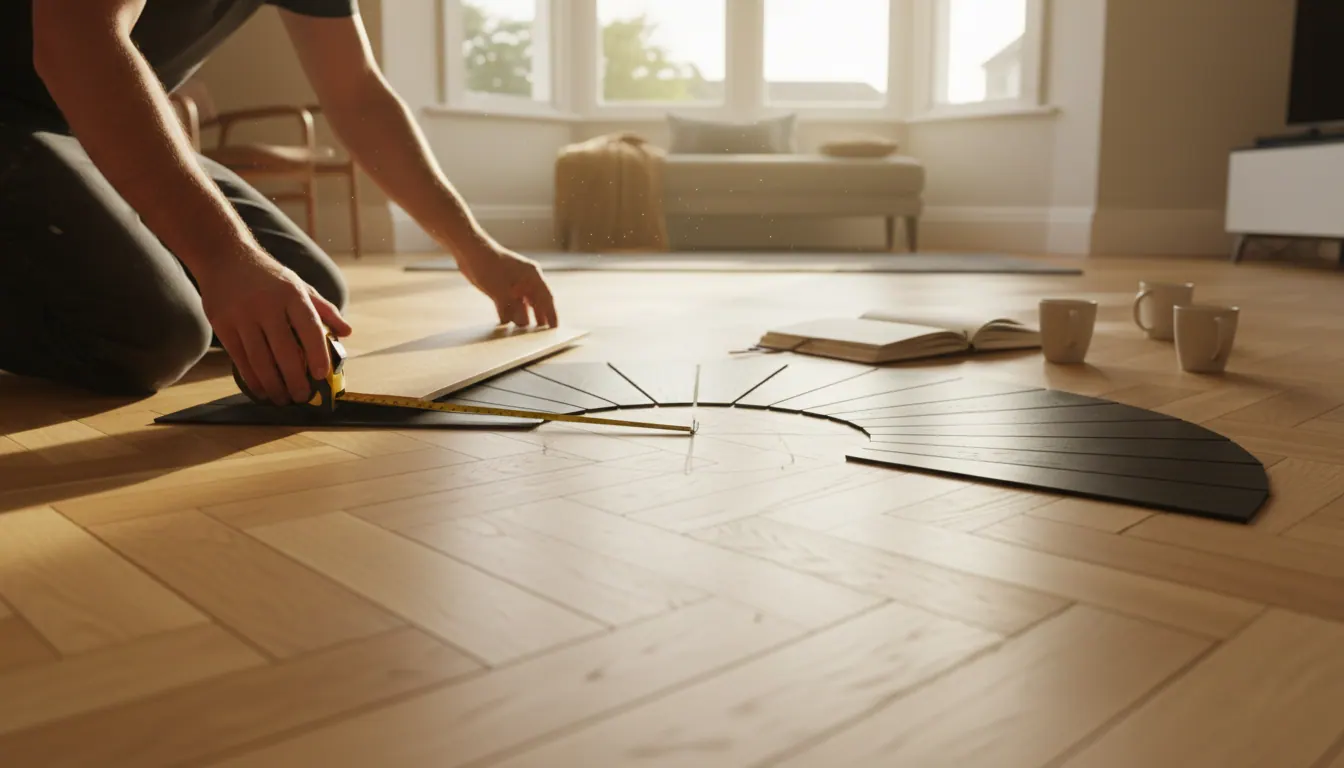
We set out herringbone from the centre of the room outward. That means:
- Finding the true centre point of the room (which in a Victorian terrace or an older Warrington property is rarely where you expect it to be, because the walls are rarely square).
- Establishing a perfectly straight working line along the length of the room.
- Dry-laying a run of planks along that line before any adhesive or click-locking begins, so we can see exactly how the pattern will behave at every edge and doorway.
- Adjusting the centre line if necessary so that the border cuts are balanced and no cut piece is thinner than half a plank width.
This process takes time. It is not glamorous. But it is the reason a finished herringbone floor looks intentional rather than accidental.
LVT herringbone versus laminate herringbone: which is right for your Warrington home?
Both formats come in herringbone plank sizes, and both can look excellent. The choice usually comes down to what the room is doing and what the subfloor is like.
LVT (luxury vinyl tile) is our most common choice for herringbone in Warrington homes, for a few reasons. It is fully waterproof, so it works in kitchen-diners and utility rooms as well as living spaces. It is dimensionally stable, meaning it does not expand and contract with the temperature changes you get in older properties with solid floors or draughty ground floors. And because LVT is glued or clicked directly to the subfloor with no floating gap, the herringbone pattern stays tight over time.
For homes in areas like Orford, Bewsey or Padgate, where older housing stock often means solid concrete subfloors and some variation in temperature through the winter, LVT is a practical as well as a beautiful choice.
Laminate herringbone tends to suit rooms where the subfloor is timber and relatively stable, and where the room is not exposed to moisture. It can look very good in a first-floor bedroom or a formal sitting room. The limitation is that laminate floats on the subfloor, and a herringbone pattern has a lot of short plank ends meeting each other. If the subfloor has any movement or unevenness, those joints can telegraph through. Which brings us to the subfloor.
The subfloor decides the finish
We say this on almost every job, and it is just as true for herringbone as for any other pattern. A herringbone layout makes subfloor imperfections more visible, not less, because the diagonal lines of the pattern draw the eye across the whole floor rather than along it. Any hollow, hump or flex will show.
Before we lay herringbone, we check the subfloor for:
- Level variation (anything beyond a couple of millimetres over a metre needs addressing).
- Movement or flex in timber boards or sheet materials.
- Contamination such as old adhesive, paint or a surface that will not bond.
- Moisture in solid floors, which can lift an adhesive-fixed LVT over time.
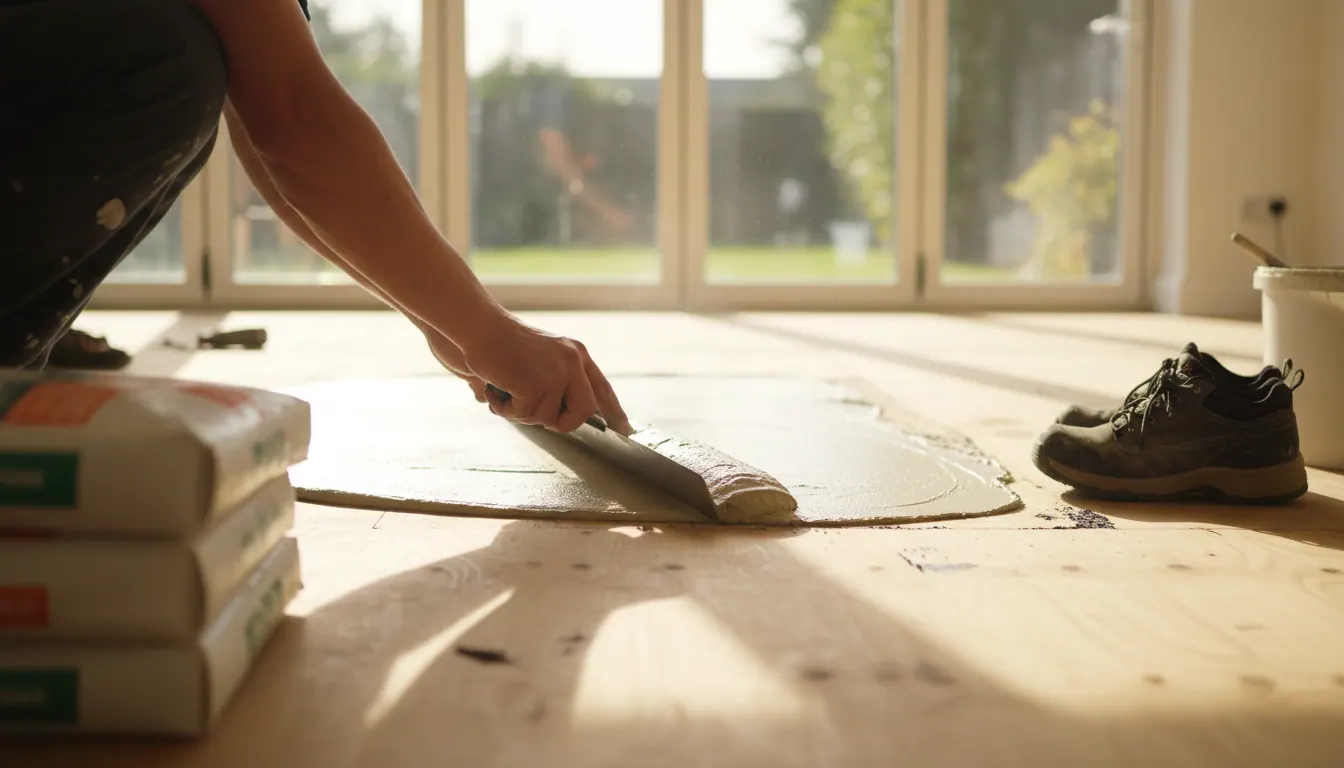
Where the subfloor needs work, we use a latex levelling compound to bring it to a smooth, flat surface. It is not an optional extra. It is the foundation that makes the finished floor possible.
If you have recently had an extension or a knock-through in your Warrington home and the subfloor levels are different between the old and new sections, that is a specific challenge we deal with regularly. Our article on why subfloor preparation makes or breaks your new flooring in a Warrington extension goes into the detail of how we handle those transitions.
What a well-laid herringbone floor actually looks like
James, one of our recent customers, had herringbone fitted throughout his home. His words say it better than we can:
"Really pleased with our herringbone flooring throughout the house and everything was finished to a high standard. The lads were great from start to finish and we would highly recommend"
, James Sumner
Running herringbone through multiple rooms is a particular challenge because the pattern has to flow consistently from one space to the next. The setting-out line established in the main room has to be carried through doorways so that the pattern reads as continuous rather than restarted. Getting that right across a whole house is the kind of detail that shows in the finished result.
Is herringbone going to date?
It is one of the most common questions we hear. The honest answer is no, and the reason is simple: herringbone is not a trend. It is a pattern that has been used in flooring since the Romans were laying it in stone. It appeared in the parquet floors of Victorian and Edwardian homes across Cheshire and the North West, and those floors still look right today.
What does date is a particular colour palette or a very specific plank width that is fashionable for a season. The pattern itself is enduring. If you choose a neutral, natural-toned LVT or a classic oak-effect laminate in a herringbone lay, you are making a long-term decision, not a trend-chasing one.
Herringbone in commercial spaces
Herringbone is not just for homes. We fit it regularly in commercial settings, offices, reception areas and refurbished retail units across Warrington and the wider Cheshire area. In a commercial environment, LVT herringbone is almost always the right call: it handles foot traffic, it is easy to clean, and the visual impact of the pattern gives a professional space a considered, finished feel without the cost or maintenance of real wood parquet.
If you manage a unit or office and are planning a refurbishment, the setting-out principles are the same, but the scale and the traffic levels change the material specification. Get in touch and we can talk through what makes sense for your space.
Frequently asked questions
Is herringbone flooring going to look dated in a few years? No. Herringbone is one of the oldest flooring patterns in use and it has not dated in centuries. What ages is a very trend-specific colour or finish, not the pattern itself. Choose a classic tone and a quality LVT or laminate, and the floor will look right for many years.
Is LVT better than laminate for herringbone in an older Warrington home? For most of the older housing stock in Warrington, yes. LVT is waterproof, dimensionally stable and glues directly to the subfloor, which means the herringbone joints stay tight even in rooms that see temperature variation or some moisture. Laminate can work well in dry, stable rooms on upper floors, but in ground-floor rooms or areas near kitchens and utilities, LVT is the more reliable choice.
Where can I find herringbone flooring in Warrington? We are a supply and fit flooring contractor serving Warrington and the surrounding area. We supply the material and lay it, so you are not managing two separate suppliers. If you want to see samples before committing, get in touch and we can arrange that.
How much does herringbone flooring cost? We do not publish prices because the honest answer is that it depends on the room size, the material you choose, and the condition of the subfloor. A room that needs significant levelling before the lay is a different job from one that is already flat and clean. Message us with the details of your project and we will give you a straightforward quote.
Your floor, our signature
Herringbone is one of the most rewarding floors to lay well, and one of the most unforgiving when the groundwork is skipped. If you are planning herringbone flooring in Warrington or anywhere across Cheshire and the North West, we would be glad to take a look at the space, assess the subfloor and talk through the right material for what you need.
Get in touch with us and we can start from there.